
All information is based on current medical research (2018–2026). Written specifically for patient education by Dr. Antonio Gargiulo (advanced endometriosis surgery) and Dr. Melanie Kappadakunnel (gastroenterology). This article does not replace a consultation with your gynecologist, gastroenterologist, or healthcare provider.
“But My Colonoscopy Was Normal”
It is one of the most common — and most dangerous — sentences we hear: “My colonoscopy came back normal, so my bowel is fine.”
Endometriosis frequently involves the bowel, and when it does, it produces symptoms that look exactly like a gut disorder — cramping, bloating, constipation, diarrhea, painful bowel movements, sometimes cyclic rectal bleeding. (Our companion article covers why endometriosis and irritable bowel syndrome are so easily confused, and how to recognize the difference.) This article picks up the next question: once endometriosis of the bowel is genuinely suspected, how is it actually found — and why does the test most women expect to catch it so often fail?
One of us (Dr. Gargiulo) operates on bowel endometriosis; the other (Dr. Kappadakunnel) performs the colonoscopies and decides whether abdominal pain is coming from the gut. We wrote this together because the single most damaging piece of false reassurance in this whole field is a “normal” colonoscopy — and it takes both of us to explain exactly why.
The Colonoscopy Trap — Why “Normal” Doesn’t Mean “Clear”
Let’s be very concrete, because this is the heart of the matter.
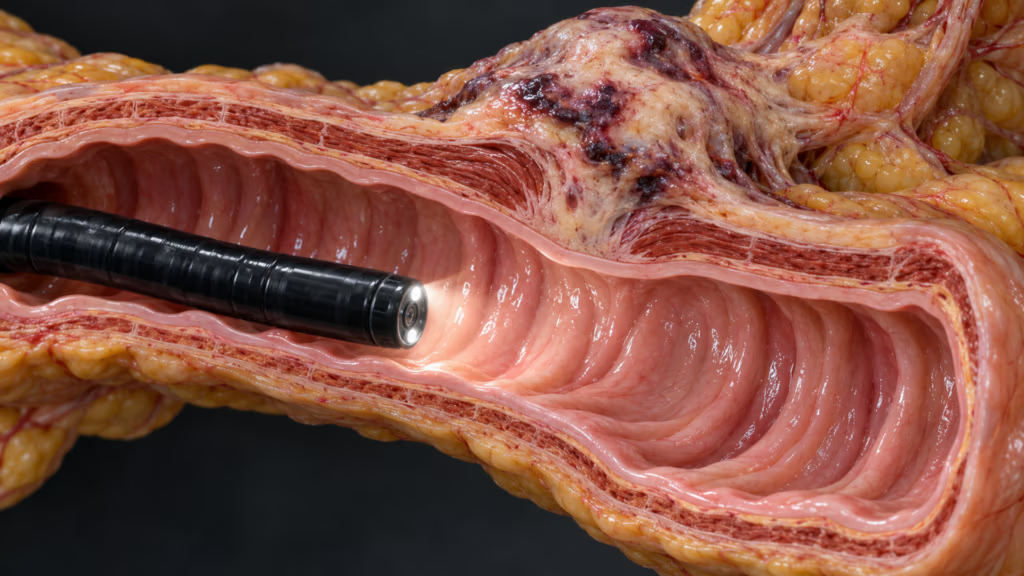
A colonoscopy is a superb test — for the diseases it is designed to find. A camera on a flexible tube travels through the inside of your colon and inspects the inner lining (the mucosa). It is excellent at spotting polyps, colon cancer, ulcerative colitis, Crohn’s disease, and other conditions that live on that inner surface.
Endometriosis in the bowel is different in a way that matters enormously: it usually grows from the outside in. It starts on the outer wall and the muscle layers and only rarely breaks all the way through to the inner lining where the camera can see it. Look at the figure below, from a study of 76 women with surgically proven bowel endometriosis: half the lesions sat in the outermost layer and about a third in the muscle, while only about 3% reached the inner lining[1].
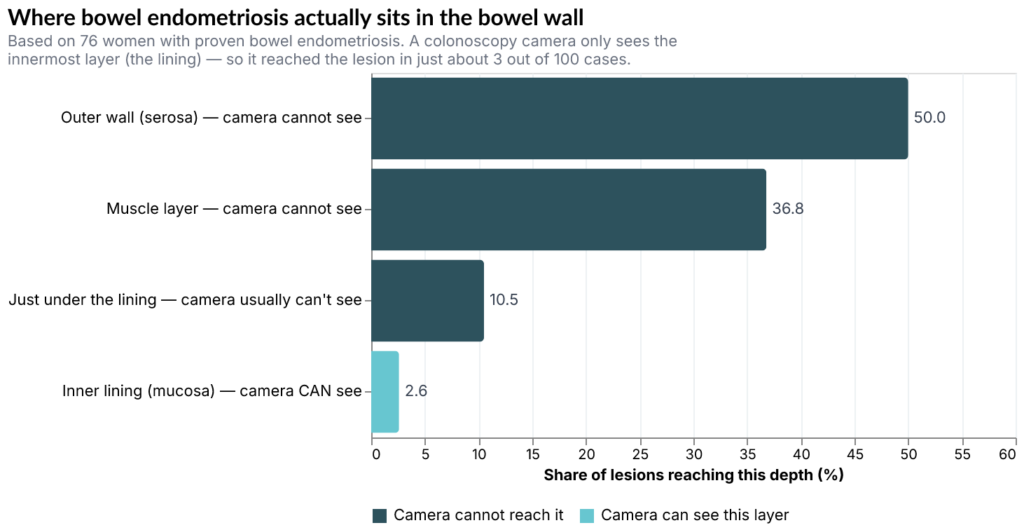
Figure 1. In 76 women with surgically proven bowel endometriosis, most lesions sat in the outer layers of the bowel wall — 50% in the outer serosa and about 37% in the muscle layer — and only about 3% reached the inner lining (mucosa), the only layer a colonoscopy camera can see. That is why colonoscopy caught only 7 in 100 cases and missed 92%.
The consequence is stark. In that same study, colonoscopy failed to diagnose bowel endometriosis in 92% of the women who actually had it — its sensitivity was just 7%[1]. A separate study of women with cyclic rectal bleeding — the group you’d most expect a colonoscopy to help — found the colonoscope proved endometriosis in only 1 of 24 patients (about 4%), and concluded that because its findings are so nonspecific, colonoscopy “should not be performed to diagnose endometriosis infiltrating the bowel wall”[2].
So why do it at all? Because it still has a real and important job: ruling out the other things. A colonoscopy is very good at excluding cancer and inflammatory bowel disease, which can mimic these symptoms and which you absolutely do not want to miss.
It is a “rule-out-the-dangerous-look-alikes” test, not a “rule-in-endometriosis” test.
There is one important nuance in the other direction, and honesty requires including it. In expert hands, an examiner who is specifically hunting for the indirect signs of bowel endometriosis — a stiff, tented, or kinked segment, or tenderness at a fixed spot — and who biopsies at the right moment can do considerably better than dismal 7%[3]. It is important to note as well that when endometriosis is rarely detected on colonoscopy, a large portion of those patients have never had a diagnosis of endometriosis (since the gastroenterologist was looking for inflammatory bowel disease or colon cancer, based on their symptoms). In a 2026 study of 150 GI cases of endometriosis in the appendix, sigmoid, and rectum, 97% of these patients had never been diagnosed with endometriosis prior to the colonoscopy. [4]
At the table: Antonio & Melanie
Melanie (gastroenterologist): This is the conversation I have most often. A patient says, “But my colonoscopy was normal — doesn’t that mean my bowel is fine?” And I have to explain that the most normal-looking superficial layer (superficial from the colonoscopy view), called the mucosa, can be sitting right on top of a nodule of endometriosis in the deeper muscle wall that my camera will never see.
Antonio (endometriosis surgeon): I’ve operated on those exact nodules. The inner lining looked pristine on her colonoscopy report, and there’s a firm endometriosis mass in the bowel wall underneath. A normal colonoscopy told the patient that the colon cancer risk was low. It told her nothing about whether she had endometriosis.
What this means for you: If you have cyclic bowel symptoms and were reassured by a normal colonoscopy, that reassurance covers colon cancer and colitis — not endometriosis. Ask specifically: “Does my normal colonoscopy rule out endometriosis in the bowel wall?” The correct answer is no.
The Menstrual-Timing Trick
Here is a clever wrinkle that can rescue a diagnosis when a standard colonoscopy comes up with an empty diagnosis.
Because an endometriosis lesion swells and can bleed with your period, a biopsy taken during menstruation, aimed at a suspicious spot, is far more likely to capture diagnostic tissue than one taken at a random point in the cycle. In one report, two women whose earlier standard endoscopies were inconclusive were finally, definitively diagnosed only when the biopsy was repeated during their period — sparing them diagnostic delay and possibly a poorly planned laparoscopic surgery that could have missed bowel endometriosis or left it untreated [5]. In another, a colonoscopy repeated during menstruation showed the lesion had grown visibly thicker, and the targeted biopsy at that moment revealed the endometrial tissue[6].
This evidence comes from case reports, so we present it as a smart, low-risk strategy in the right patient — not a proven protocol. But if you have cyclic rectal bleeding and a suspicious spot was seen, the timing of the colon biopsy can make the difference between an answer and another dead end.
What this means for you: If bowel endometriosis is suspected and a lesion was seen on a scope, ask whether repeating a targeted biopsy during your period might improve the odds of a clear answer.
The Tests That Actually Map Bowel Endometriosis
If colonoscopy can’t see it, what can? The tools that image the whole thickness of the bowel wall and the pelvis around it: expert transvaginal ultrasound and MRI.
When these are done by specialists, they are genuinely excellent. A meta-analysis comparing them head-to-head in the same patients found that both transvaginal ultrasound and MRI reached about 90% sensitivity and 96% specificity for rectosigmoid (lower bowel) endometriosis — and using them together pushed the confidence of a positive finding to nearly 100%[7]. That lower stretch of bowel, the rectosigmoid, is where roughly 90% of bowel endometriosis lives, so a focused expert exam covers most of the territory[7].
The essential caveat is that these tests are only as good as the person performing and reading them. “Expert” is doing real work in that sentence. A standard pelvic ultrasound looking for normal ovaries and uterus is simply not the same test as a dedicated deep-endometriosis scan by someone trained to find deep endometriosis.
At the table: Antonio & Melanie
Antonio: This is where the map gets drawn. Before I operate, I want to know how deep a bowel nodule goes into the layers of the bowel wall, how large it is, how much of the wall circumference it involves, and how close it sits to other key structures. A good MRI or expert ultrasound tells me that. A colonoscopy can’t.
Melanie: And from my side, once cancer and IBD are off the table, I’m happy to hand the steering wheel to imaging and to Antonio’s team. That’s not losing the patient — that’s getting her on the right track.
A Different Beast — Inflammatory Bowel Disease
Not every serious gut condition is a look-alike to be dismissed. Inflammatory bowel disease (IBD) — Crohn’s disease and ulcerative colitis — is a genuine, often dangerous inflammation of the bowel itself, and it deserves its own mention here for two reasons.
First, endometriosis and IBD are modestly linked. A large nationwide Danish study of nearly 38,000 women found that having endometriosis was associated with about a 50% higher risk of later developing IBD, a link that persisted even 20 years out and was, if anything, stronger in surgically confirmed cases[8]. A systematic review put the numbers in perspective: IBD showed up in roughly 2–3.4% of women with endometriosis versus about 0–1% of women without it — a real but still uncommon association[9].
Second — and this is the reassuring part — having endometriosis does not appear to make IBD worse. A 2025 multicenter study actually found that women who had both conditions had a milder Crohn’s course and needed fewer strong immune-suppressing drugs, not more[10].
How does a gastroenterologist tell IBD apart from endometriosis or a functional gut disorder? Unlike a functional disorder, IBD leaves fingerprints: blood tests showing inflammation, a stool test called fecal calprotectin, and — here colonoscopy shines — visible ulcers and inflammation on the inner lining, confirmed by biopsy. Those “alarm features” (unintended weight loss, fevers, anemia, persistent non-cyclic bleeding, nighttime urgency or pain) are exactly what should not be waved off.
At the table: Antonio & Melanie
Melanie: This is the flip side of Section 1. A normal colonoscopy doesn’t rule out endometriosis — but an abnormal one with inflammation and ulcers is how I catch IBD, which endometriosis imaging would miss. Each test has a lane.
Antonio: Which is the whole argument for doing this together. Her tools catch what mine miss, and mine catch what hers miss. Foregoing colonoscopy simply on the suspicion of endometriosis is always ill-advised.
SIBO and the Microbiome — Real, but Oversold
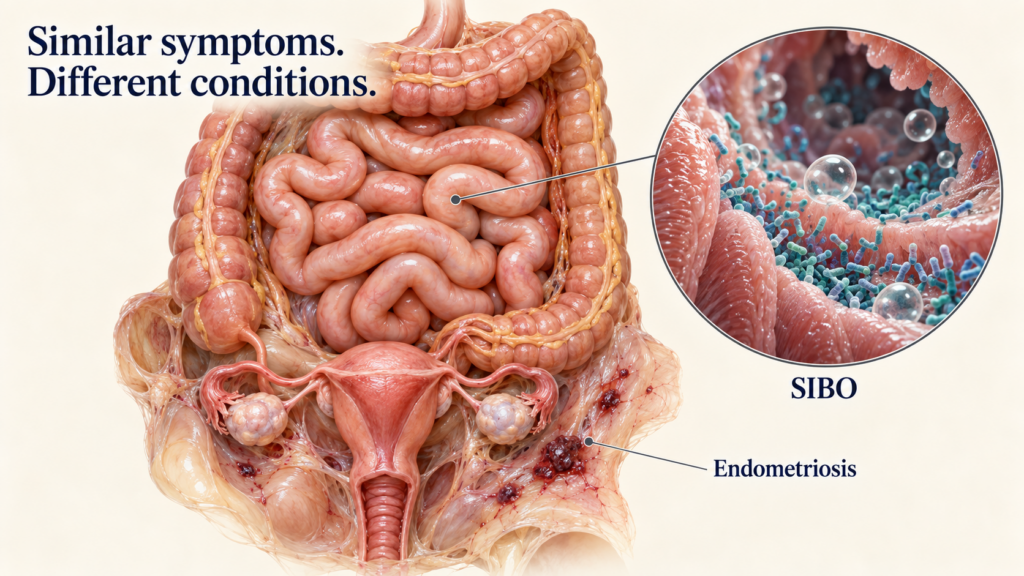
You may have read that women with endometriosis often have SIBO — small intestinal bacterial overgrowth, an excess of bacteria in the small intestine that can cause bloating, gas, and altered bowel habits. There is a kernel of truth here, wrapped in a lot of hype.
A 2025 case-control study did find SIBO (and a methane-producing variant) common in women with endometriosis — positive in about 92% of those tested, versus about 83% of the comparison group[11]. But read those numbers again: the rate was sky-high in both groups, because these were women who had come in for breath testing during a health check, not the general population[11]. The difference between endometriosis and no endometriosis was modest, and breath tests for SIBO are notoriously prone to false positives. So the fair summary is: bloating and altered transit are genuinely more common in endometriosis[10], SIBO is worth testing for when symptoms fit, but it should be evaluated and treated on its own merits — not assumed to be caused by your endometriosis, and not used as a substitute for looking for the real driver of your pain.
The related idea that the gut microbiome (the community of bacteria in your intestines) differs in women with endometriosis is real but much earlier-stage. Reviews consistently find an altered gut microbiome and see future potential for diagnosis and treatment, but they are equally clear it is not yet ready to act on[12].
At the table: Antonio & Melanie
Melanie: SIBO is having a moment on social media, and I do diagnose and treat it. But I treat it because the symptoms warrant it — not because a patient has endometriosis. And the two can often go together. A course of antibiotics for SIBO won’t touch a nodule in the bowel wall.
Antonio: And I’ve seen women spend a year and a lot of money chasing SIBO and microbiome protocols while the actual endometriosis kept growing. Treat the SIBO if it’s there. Just don’t let it become the reason that delays the diagnosis that matters.
Bring This to Your Appointment: Questions to Ask Your Gastroenterologist
You do not need to be an expert to steer your own work-up. You just need to ask the right questions and expect real answers. Copy this list, or take a screenshot, and bring it with you.
Your checklist
- “Does my normal colonoscopy rule out endometriosis in the bowel wall?” (The honest answer is no — a colonoscopy inspects the inner lining, but most bowel endometriosis sits in the deeper layers it can’t see, and it misses the disease in about 92% of women who have it.[1])
- “What was my colonoscopy actually good at ruling out?” (Cancer and inflammatory bowel disease — real dangers you want excluded — not endometriosis.)
- “Do my bowel symptoms follow my menstrual cycle?” Bring a 2–3 month symptom-and-period diary so the pattern is visible. Cyclic symptoms, especially cyclic rectal bleeding, point toward endometriosis rather than a routine gut disorder. “Should I have an expert transvaginal ultrasound or MRI to look for bowel endometriosis?” (Done by specialists, these reach roughly 90% sensitivity and 96% specificity for lower-bowel disease.[7])
- “If a lesion was seen, would a targeted biopsy timed to my period improve the odds of a clear answer?” Yes. Make sure to time your colonoscopy around the time of your cycle.
- “Do my symptoms suggest inflammatory bowel disease?” Ask about inflammation blood tests and a stool test called fecal calprotectin, especially if you have alarm features (weight loss, fevers, anemia, non-cyclic bleeding, nighttime urgency or pain).
- “Is SIBO worth testing on its own merits — and if it’s treated, what’s the plan if pain remains?” (Treating SIBO for some underlying gut symptoms, but it won’t touch an endometriosis nodule in the bowel wall.)
- “Can you and my gynecologist compare notes on my case?” The best answers come when the two specialties talk to each other instead of taking turns.
What this means for you: If any of these questions is met with a shrug or a brush-off, that is useful information too. You are entitled to a clinician who will engage with them.
Our Take: Don’t Let a Normal Colonoscopy Close the Case
After all of this, here is where the two of us land, together.
A normal colonoscopy rules out cancer and IBD — it does not rule out endometriosis in the bowel wall, which it misses more than 90% of the time[1]. When endometriosis is the question, the answers come from expert transvaginal ultrasound and MRI, not from the scope[7].
Match the test to the question. Colonoscopy for the dangerous look-alikes; expert imaging to map the endometriosis; a well-timed biopsy when cyclic bleeding needs tissue proof[5]. And treat a genuine gut problem like SIBO on its own merits — without letting it become the reason the real diagnosis waits.
Get the two specialties in the same room. The biggest mistakes we see happen in the gaps between specialists — the normal colonoscopy treated as a final verdict, the imaging that never gets ordered. When a gastroenterologist and an endometriosis surgeon compare notes on the same patient, far fewer women fall through those gaps.
A Note on Being Believed
If there is a single thread running through this article, it is this: a “normal” result on the wrong test is not the same as being healthy. Women with pelvic and bowel pain are too often reassured by a colonoscopy that was never capable of answering their question, then sent away for years. You are allowed to ask for more. You are allowed to say, “My colonoscopy was normal, but my symptoms follow my period — what could my scope have missed?” You are allowed to ask your gynecologist and your gastroenterologist to actually talk to each other.
Good medicine here is not one brilliant specialist. It is two ordinary specialists who bother to compare notes. That is the care we would want for our own families, and it is the care you should expect.
Continue reading: “Is It IBS — or Is It Endometriosis?” — why these two conditions are so easily confused, how often they coexist, and the red flags that tell them apart.
Sources We Used
So You Can Read Them, Question Them, and Decide for Yourself
We believe that informed patients are empowered patients. In an age where artificial intelligence and open-access science place original research within reach of anyone, you have every right to go to the source, read it yourself, and form your own conclusions. Patient education on this website is taken seriously: we do not simplify at the cost of truth, and we do not ask you to take our word for it.
Every statement in this article carries two layers of accountability. It has been filtered through the combined clinical judgment of Dr. Antonio Gargiulo, drawing on four decades of experience in reproductive medicine and advanced gynecologic surgery, and Dr. Melanie Kappadakunnel, who has the experience of several years in gastroenterology. And it is independently traceable to a peer-reviewed publication or primary source, listed below, so you can retrieve and read the original at any time.
We see healthcare as a shared responsibility between doctors and patients — and, when the problem crosses specialties, a shared responsibility between doctors and each other. Shared responsibility requires shared access to information. These references are not a formality. They are here for you.
- Milone M, Mollo A, Musella M, et al. Role of colonoscopy in the diagnostic work-up of bowel endometriosis. World Journal of Gastroenterology. 2015.
- Lüchinger AB, Voboril R, Nagele F, et al. Cyclic Hematochezia: A Sign of Intestinal Endometriosis? An Evaluation by Magnetic Resonance Imaging and Colonoscopy. Archives of Gynecology and Obstetrics. 2011.
- Kim K-J, Jung SS, Yang S-K, et al. Colonoscopic Findings and Histologic Diagnostic Yield in Patients with Colorectal Endometriosis. 2009.
- Jamshed A, et al. Gastrointestinal Tract Endometriosis: Clinicopathologic Features and Anatomic Distribution in an Institutional Cohort. Human Pathology, 2026;175:106171.
- Lukovich P, Csibi N, Rigó J, et al. Prospective study to determine the diagnostic sensitivity of sigmoidoscopy in bowel endometriosis. Orvosi Hetilap. 2017. DOI: 10.1556/650.2017.30663
- Tanaka K, Nishimura N, et al. A Targeted Biopsy during Menstruation for the Definitive Diagnosis of Rectovaginal Endometriosis: A Report of Two Cases. Internal Medicine. 2020. DOI: 10.2169/internalmedicine.5430-20
- Kido K, et al. Endometriosis in the Sigmoid Colon Diagnosed by Target Biopsies During Menstruation. Gastro Hep Advances. 2022.
- Moura APC, Ribeiro HSAA, Bernardo WM, et al. Accuracy of transvaginal sonography versus magnetic resonance imaging in the diagnosis of rectosigmoid endometriosis: Systematic review and meta-analysis. PLOS ONE. 2019. DOI: 10.1371/journal.pone.0214842
- Jess T, Frisch M, Jørgensen KT, et al. Increased risk of inflammatory bowel disease in women with endometriosis: a nationwide Danish cohort study. Gut. 2011.
- Chiaffarino F, Cipriani S, Ricci E, et al. Endometriosis and inflammatory bowel disease: A systematic review of the literature. European Journal of Obstetrics & Gynecology and Reproductive Biology. 2020.
- Guillo L, Delau O, Coelho-Prabhu N, et al. Impact of Endometriosis on the Progression of Inflammatory Bowel Diseases: A Multicenter Retrospective Study. Clinical and Translational Gastroenterology / American Journal of Gastroenterology. 2025.
- Halfon P, Nicolas-Boluda A, Nezhat C, et al. High prevalence of small intestinal bacterial overgrowth and intestinal methanogen overgrowth in endometriosis patients: A case–control study. International Journal of Gynecology & Obstetrics. 2025. DOI: 10.1002/ijgo.70005
- Weber I, et al. Relationship between the gut microbiome and endometriosis and its role in pathogenesis, diagnosis, and treatment: a systematic review. Ginekologia Polska. 2023. DOI: 10.5603/gpl.97581