
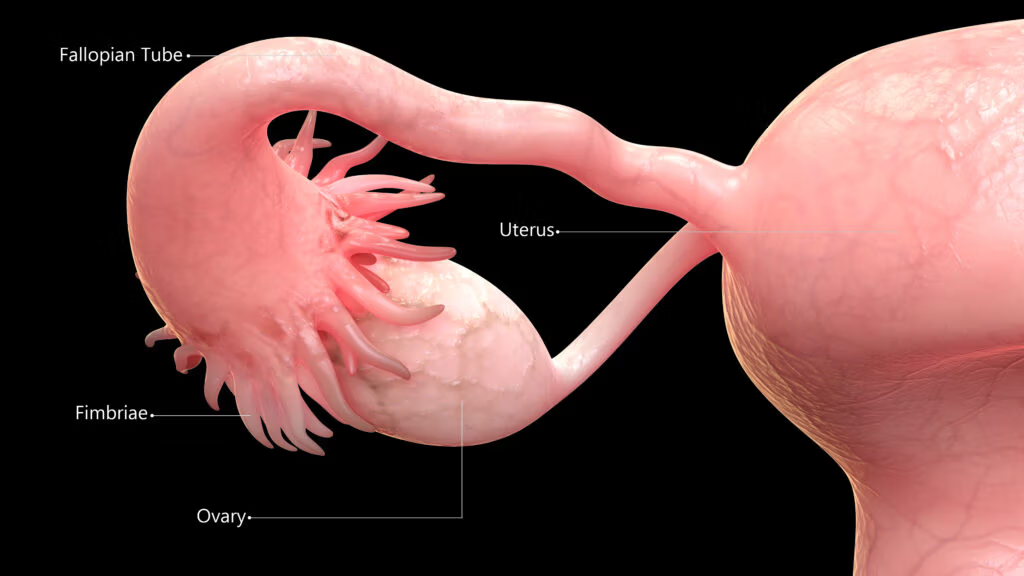
All information is based on current medical research (2018–2026). Written specifically for patient education by Dr. Antonio Gargiulo. This article does not replace a consultation with your gynecologist or healthcare provider.
Why a Fertility Doctor Is Telling You to Consider Removing Your Tubes
I am a fertility doctor. My entire career has been spent helping women keep their reproductive organs and use them to build families, so writing an article that urges you to consider having your fallopian tubes removed feels almost hyperbolic coming from me. I am writing it anyway — because surgeons do not promote this simple, potentially life-saving practice nearly enough, and too many women are never offered it.
Here is the idea that turned gynecology on its head over the last two decades: the deadliest kind of “ovarian” cancer very often doesn’t start in the ovary at all. It starts in the fallopian tube. That single discovery created a rare thing in medicine — a chance to prevent a lethal cancer with a small, add-on operation that leaves your ovaries, your hormones, and your body otherwise untouched.
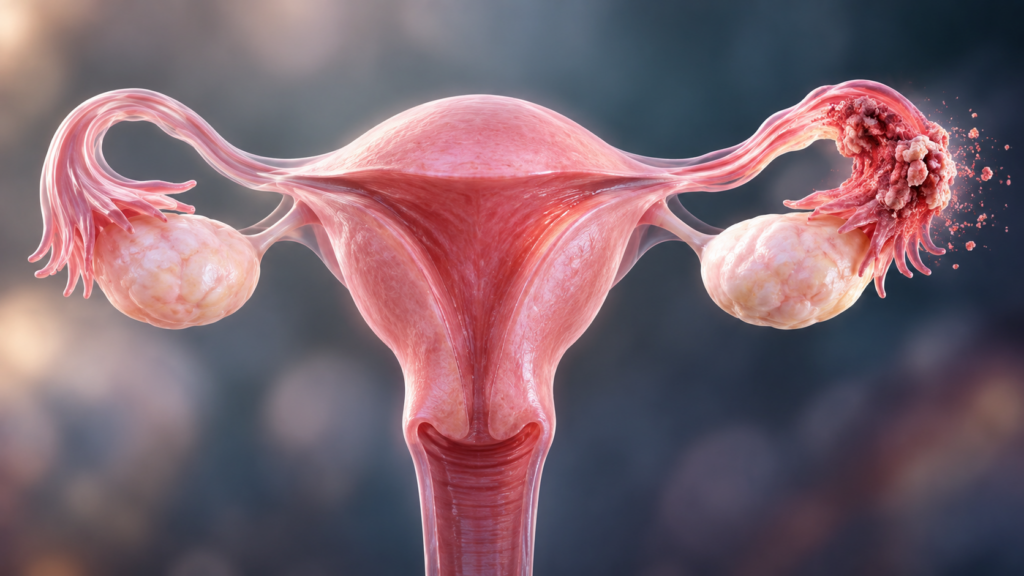
Current evidence indicates that many high-grade serous ovarian cancers originate in the distal fallopian tube (fimbria), rather than in the over itself.
The operation is called opportunistic salpingectomy (say it sal-pin-JECK-toe-mee — it just means removing the fallopian tubes). “Opportunistic” is the key word: it means doing it while you’re already having another pelvic operation — a hysterectomy, a permanent-contraception procedure, sometimes even an unrelated abdominal surgery — so it costs you almost nothing extra and spares you a second trip to the operating room. This article explains where this idea came from, how strong the evidence really is, and — the question every one of my patients asks — whether it will wreck your hormones. (Spoiler: the evidence says it doesn’t.)
The Old Belief — “It’s Called Ovarian Cancer, So It Must Start in the Ovary”
For a hundred years, the logic seemed airtight. The cancer showed up on and around the ovary, so surgeons and scientists assumed the ovary’s outer skin — the ovarian surface epithelium — was where it began[1]. That belief shaped everything: how we screened for it, how we imagined preventing it, where we looked.
It also made ovarian cancer feel almost impossible to stop. By the time this cancer causes symptoms, it has usually already spread across the pelvis and belly, coating the ovaries, tubes, and surrounding surfaces — which made it genuinely hard to tell where the very first cancer cell had been[1]. And the biggest screening trial ever done delivered a crushing verdict: screening healthy women found some cancers a bit earlier but did not save lives[2]. So prevention — not detection — became the only game worth playing.
The trouble was that the one prevention that clearly worked — removing the ovaries — carries its own heavy price in women who still have them. Taking out the ovaries before natural menopause throws a woman into surgical menopause and is linked to higher rates of heart disease, osteoporosis, and death from other causes[2]. You can’t hand that to a 35-year-old at average risk just in case. Medicine was stuck.
What this means for you: for decades, the name of the disease pointed everyone at the wrong organ, and the only proven prevention was too drastic for ordinary-risk women. That’s the box the tube discovery finally broke us out of.
The Scientific Revolution — Following the Trail to the Fimbria
The break came from an unglamorous place: pathologists looking very carefully at tubes and ovaries removed from women who carried BRCA gene mutations — the inherited flaws that drive ovarian-cancer risk sky-high.
When those women had risk-reducing surgery, pathologists kept finding the earliest cancer changes not on the ovary, but at the far, feathery end of the fallopian tube — a fringe called the fimbria that drapes over the ovary[3]. They named the tiny lesion they found there serous tubal intraepithelial carcinoma, or STIC — think of it as a cancer’s first footprint, still sitting inside the lining of the tube[1]. Often, right beside it, they found an even earlier fingerprint: a patch of cells carrying a mutation in the p53 gene, the so-called “p53 signature”[3].
Then the genetics sealed the case. When researchers sequenced the DNA of these tubal lesions and the matching ovarian cancers from the same women, the ovarian tumors carried the same defining mutations already present in the tube — the same TP53, BRCA1, BRCA2, PTEN changes[3]. In other words, the tube wasn’t an innocent bystander — it was the crime scene. The same team even estimated the timeline: roughly seven years pass between a STIC forming in the tube and a full ovarian cancer taking hold, with spread following quickly after[3].
This matters enormously for one reason: the most common and most lethal form of the disease — high-grade serous carcinoma — accounts for about 70% of sporadic cases, and roughly 85–90% of these cancers arise in women at average, general-population risk, not in known BRCA carriers[1, 2]. If the tube is the usual starting point, then removing the tube — in ordinary women, not just high-risk ones — becomes a real prevention strategy.
What this means for you: the phrase “ovarian cancer” is, for the most dangerous type, something of a misnomer. It’s frequently a fallopian-tube cancer that lands on the ovary. That’s not a technicality — it’s the whole reason your tubes are suddenly on the table.
So Why Remove Healthy Tubes? The “Opportunistic” Idea
Here’s where the strategy gets clever. Once you accept that the tube is the usual launch pad, a question follows: what is a fallopian tube actually for once a woman is finished having children? Its one job is to carry an egg. If you don’t want that job done anymore, the tube is, functionally, a small organ with no remaining benefit and a documented cancer risk.
So instead of waiting for cancer, we remove the tubes during operations women are already having:
- During a hysterectomy (removal of the uterus) for fibroids, bleeding, or prolapse — the tubes are right there and no longer serve any purpose once the uterus is gone.
- Instead of a “tube-tying” for permanent contraception — rather than clipping or burning a small segment of tube, the surgeon removes the whole tube, which prevents pregnancy and cuts cancer risk.
- During other pelvic or abdominal surgery in women who’ve completed childbearing — increasingly, even non-gynecologic operations are seen as an opening to offer it[4].
The single most important thing to understand: the ovaries stay. Opportunistic salpingectomy removes only the tubes and deliberately leaves your ovaries in place, so they keep making hormones exactly as before[2]. This is what separates it from the drastic operation of the past. You are not being asked to trade your hormones for cancer prevention. You are being asked to give up an organ you’re no longer using.
What this means for you: “opportunistic” is not a hedge word — it’s the entire point. The tube removal piggybacks on surgery you’re already undergoing, adding minimal risk while your ovaries and hormones ride through untouched.
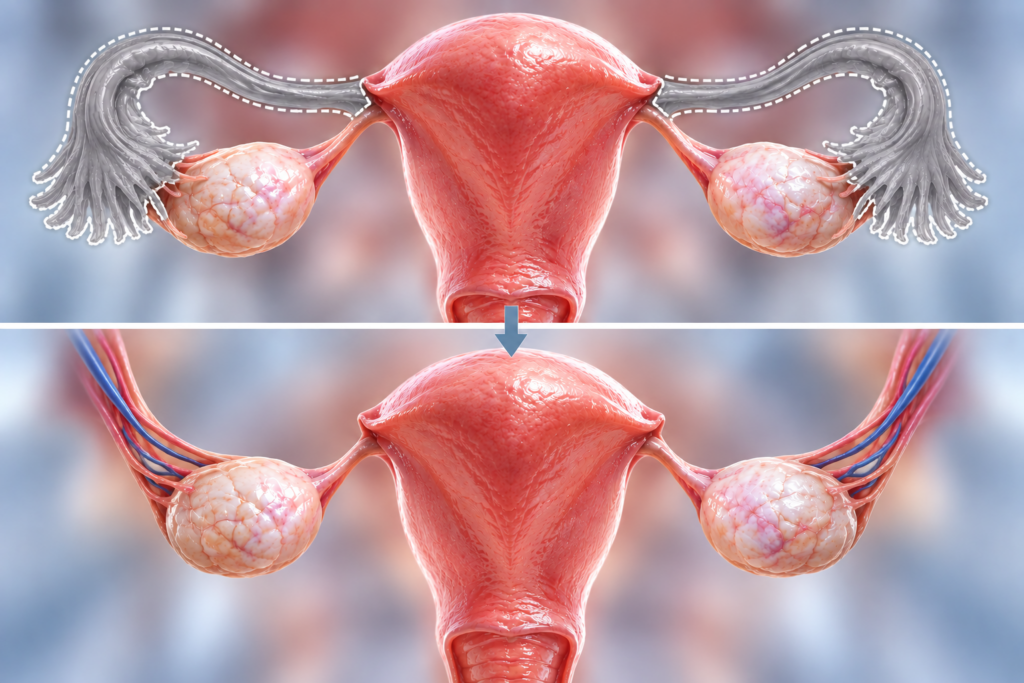
Opportunistic Salpingectomy removes only the fallopian tubes while preserving both ovaries, their blood supply, and normal ovarian function.
Does It Actually Work?
This is the fair question, and the honest answer is: the evidence is strong and consistent, though not yet from the kind of randomized trial we’d love to have (you cannot easily randomize tens of thousands of women and wait 30 years for cancers to appear).
Start with the population studies. Across national datasets from Sweden, Denmark, and the US, women who’d had their tubes surgically removed had roughly a 42% to 65% lower risk of ovarian cancer than women who hadn’t[2]. A large meta-analysis pooling 77 studies — over 3,500 women who had salpingectomy against millions of controls — found the risk cut roughly in half[5].
Then came the study that made believers of the skeptics. In British Columbia, surgeons launched a province-wide campaign back in 2010 to remove tubes opportunistically. Researchers later followed 25,889 women who’d had opportunistic salpingectomy and compared them with 32,080 who’d had a hysterectomy or tube-tying alone.
The result was startling: not a single serous ovarian cancer occurred in the tube-removal group, versus about 5.3 expected based on the comparison group[2]. And this wasn’t a fluke of healthier patients — the same women had exactly the expected numbers of breast and colon cancers, which tells us the missing ovarian cancers were the result of the surgery, not some accident of who chose it[2].
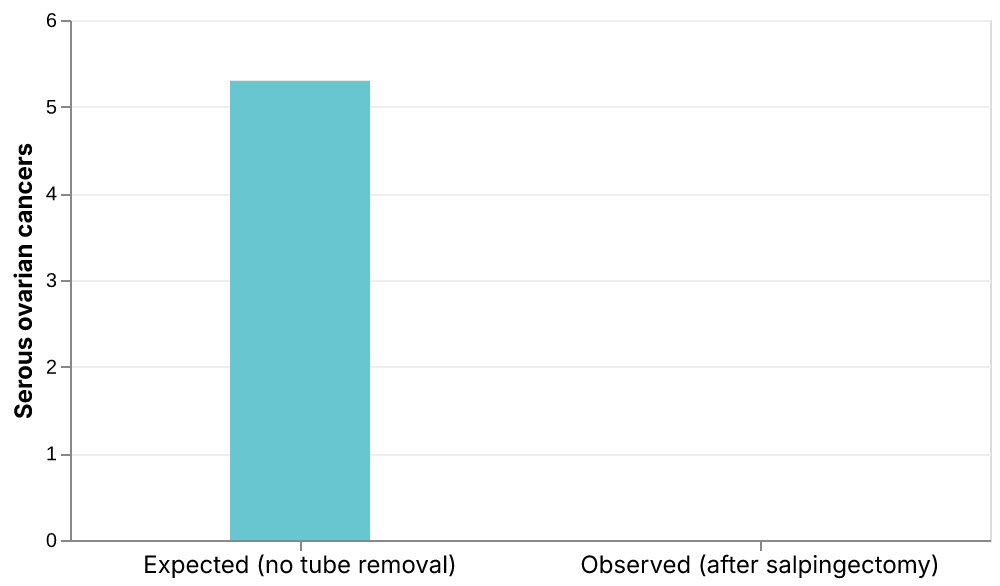
Figure 1. In a British Columbia cohort of 25,889 women who had opportunistic salpingectomy, zero serous ovarian cancers occurred versus about 5.3 expected from the comparison group.
How much protection is that, really? The most careful researchers won’t claim it prevents every case. Their best estimate is that opportunistic salpingectomy reduces risk on the order of 80% — similar to the protection BRCA carriers get from removing tubes and ovaries together[2, 5]. Scaled up, a systematic review of 158 studies concluded that if this were done widely, it could cut ovarian-cancer deaths in the US by an estimated 15%[5]. Another analysis estimated that adding tube removal to sterilizations and other surgeries could prevent thousands of cancers a year[5].
What this means for you: no honest doctor will promise a normal-risk woman that removing her tubes drops her personal risk to zero — it doesn’t, and some cancers still arise from the ovary or peritoneum[6]. But the direction and size of the effect are impressive and consistent across many countries and study designs. This is about as much evidence as we ever get for a prevention strategy short of a decades-long randomized trial.
When the Cancer Does Start in the Ovary — Endometriosis, Endometriomas, and a Different Kind of Risk
Everything so far has been about the most common and most lethal ovarian cancer — the high-grade serous type that we now know usually begins in the tube. But I run an endometriosis practice, so I owe you the other half of the story: not every ovarian cancer starts in the tube. A minority genuinely begin in the ovary itself — and those are the ones tied to endometriosis.
When endometriosis takes root on the ovary, it forms a cyst called an endometrioma (a “chocolate cyst,” named for the old, thick blood inside it). In a small number of women, the endometriosis tissue lining that cyst can, over many years, turn into cancer. When it does, it becomes one of two specific types — clear-cell or endometrioid ovarian cancer — and these are exactly the histotypes that show up far more often in women with endometriosis than in women without it[7]. The current model is that ongoing inflammation and specific genetic changes (such as mutations in a gene called ARID1A) inside the endometriosis lesion form a biological bridge from benign cyst to cancer, sometimes passing through a warning stage called atypical endometriosis[7]. This cancer is believed to grow out of the ovarian endometriosis itself[8].
Here is the part I most want you to hold onto, because the internet will scare you: the relative risk goes up, but the absolute risk stays low. Having endometriosis roughly doubles the relative risk of ovarian cancer overall, and raises the clear-cell and endometrioid types about two- to three-fold specifically[7, 8]. But because ovarian cancer is uncommon to begin with, that translates to a lifetime risk of only about 2%, compared with roughly 1% for women without endometriosis — and the actual incidence in these studies sits under 1.5%[7, 8]. The most careful researchers say plainly that this should not create disproportionate cancer anxiety[7].
The risk is also strongly tied to age. Endometriosis-associated ovarian cancer is diagnosed at an average age around 51, and it is genuinely rare in the reproductive years — only about 2 in 100 cases occur before age 45, and it is vanishingly rare before 40[8]. That is why experts say the mere presence of an endometrioma should not change how we manage most younger women, and why there is no routine cancer screening recommended just because you have endometriosis[7, 8]. What does earn a closer look — usually a detailed ultrasound and often an MRI — is an endometrioma that is growing quickly or getting large (roughly above 9 cm), one that starts showing solid nodules or unusual blood flow on imaging, or new or worsening symptoms in a woman near or past menopause[7, 8].
So what does removing the tubes mean for this kind of cancer? This is the honest, nuanced answer an endometriosis site should give. The clear-cell and endometrioid cancers grow from endometriosis on the ovary, so removing the tube does not remove an endometrioma you already have, and it is not a treatment for ovarian endometriosis. But the tube is still part of the story: the leading theory is that the genetically unstable cells that can eventually turn cancerous reach the ovary by traveling backward through the fallopian tube during menstruation. That is why blocking or removing the tube offers some protection even against these endometriosis-linked cancers, not just the serous type[9]. Tubal ligation (tying the tubes) has long been shown to lower ovarian-cancer risk, and that benefit is largely concentrated in exactly these endometriosis-associated histotypes — while full tube removal appears to protect even more[9, 10].
What this means for you: if you have endometriosis or an endometrioma, salpingectomy is a reasonable added layer of protection — it may cut off a route that feeds ovarian disease — but it is not a substitute for actually watching and, when warranted, treating the endometrioma itself. The two jobs are different. Removing the tubes lowers future risk; imaging surveillance and, in selected higher-risk cases, removing the affected cyst or ovary is what addresses disease that is already on the ovary. If you’re finished having children and heading to surgery anyway, you can reasonably do both: have the tubes removed and have your surgeon give any endometrioma the scrutiny it deserves.
What About My Hormones? (The Fear Everyone Has)
This is the question I get in my office every single time, and it deserves a real answer, not reassurance. The worry is logical: the tube runs right alongside the ovary and shares some neighboring blood vessels, so it’s natural to fear that removing it might starve the ovary or push you into early menopause[11].
Here’s the anatomy that should reassure you. The ovary has its own dedicated blood supply (the ovarian artery), separate from the tube. A careful surgeon removes the tube while staying close to it and preserving the ovary’s blood flow. So in principle, the ovary shouldn’t miss the tube at all — and the data bear that out.
Study after study measuring anti-Müllerian hormone (AMH) — the best blood marker of “ovarian reserve,” meaning the ovary’s remaining egg supply and function — has found no meaningful drop after salpingectomy. A meta-analysis of eight studies found no significant change in AMH; randomized trials comparing hysterectomy with and without tube removal found no negative effect on ovarian reserve or hormone levels[5, 11]. Larger reviews reach the same bottom line: salpingectomy during hysterectomy does not appear to harm ovarian function[11]. One study followed women three to five years afterward and found no difference in ovarian function compared with women who kept their tubes[6]. And crucially, the British Columbia data show no signal of women entering menopause earlier after tube removal[2].
I’ll add the honest caveat: most of these studies measured hormones over months to a few years, not decades, which is exactly why a long-term study specifically tracking the age women reach menopause is underway[2, 5]. But the current evidence is genuinely reassuring, and it is why every major society now endorses this.
What this means for you: removing your tubes is not the same as removing your ovaries. Your ovaries keep their own blood supply and keep doing their job. The fear of “instant menopause” from tube removal is, based on everything we can measure, unfounded.
Are There Downsides?
Yes — and you deserve the full list, not a sales pitch.
- A little more operating time. Adding tube removal lengthens the surgery modestly — roughly 10 to 16 minutes at hysterectomy or sterilization[6].
- No measurable rise in complications. This is the reassuring part. Multiple large studies and the American College of Obstetricians and Gynecologists (ACOG) agree that adding salpingectomy does not increase blood transfusions, readmissions, infections, fever, or other postoperative complications compared with the same surgery without it[6, 11].
- It is permanent and irreversible. Once the tubes are gone, they’re gone. If it’s done as your contraception, understand there’s no “reversal” later — removing the tubes eliminates tubal-reversal as a future option, so this is only for women who are certain they’ve completed childbearing[6].
- You can still have IVF. This is the piece patients don’t realize, and as a fertility doctor I want to say it plainly: removing your tubes does not end your fertility options. In vitro fertilization (IVF) bypasses the tubes entirely — we retrieve eggs directly from the ovary and place an embryo directly into the uterus, so no tubes are needed. Because your ovaries and uterus remain, IVF stays fully on the table. (This is exactly why women who choose tube removal for contraception can still pursue pregnancy later through IVF if life changes.)
There’s one honest scientific gap worth naming: we still don’t have definitive data on whether how the tube is removed — how the surgeon handles the tissue and energy devices near the ovary’s blood supply — affects long-term ovarian function. The reassuring reserve data suggest careful technique protects the ovary, but the finer surgical details remain an area where better evidence would help.
What this means for you: the trade-offs are real but modest — a few extra minutes, permanence, and the loss of tubal (not overall) fertility. For a woman who is finished having children, that’s a genuinely favorable bargain.
Who Should Actually Consider It?
Not everyone, and not at any cost. Here’s the sensible framing.
- If you’re having a hysterectomy for a benign reason and don’t need your tubes, removing them is now the routine, recommended default. In 2024, ACOG strengthened its guidance, recommending that gynecologists should routinely perform bilateral salpingectomy at the time of hysterectomy[4].
- If you want permanent contraception, complete removal of both tubes is now the preferred method — it prevents pregnancy at least as well as the old tube-tying and adds the cancer benefit[4]. Full tube removal is itself highly effective contraception[6].
- If you’re having other gynecologic surgery that enters the pelvis and you’ve completed childbearing, it should be offered[4].
- Even during some non-gynecologic abdominal surgeries, ACOG now encourages gynecologists and other surgeons to collaborate so women can take the opportunity — calling salpingectomy a “potentially life-saving procedure”[4].
- High-risk women (known BRCA carriers and others with strong family history) are a different conversation — for them, removing the ovaries as well, at the appropriate age, remains the standard because their risk is so high[2]. Tube-only removal is a general-population strategy, not a substitute for the more complete surgery high-risk women need.
Importantly, ACOG is clear that this should always follow a real conversation — shared decision making — not be done to you without discussion. And because it doesn’t erase all risk, you should still know the vague warning signs of ovarian cancer afterward (persistent bloating, pelvic pressure, early fullness, urinary urgency)[6].
What this means for you: if you’re finished having children and any pelvic surgery is on your horizon, this is a conversation to start yourself if your surgeon doesn’t. You are allowed to walk in and ask, “Since you’re already operating, should we take my tubes to lower my ovarian-cancer risk?”
My Take
Here’s where I land after some four decades in reproductive medicine and surgery.
This is one of the clearest wins in modern gynecology, and it’s shamefully under-offered. The biology is compelling — the deadliest ovarian cancer usually begins in the tube[3]. The prevention data are strong and consistent — roughly 80% risk reduction, and in one large cohort, zero serous cancers where five were expected[2]. The safety data are reassuring — no meaningful hit to hormones or ovarian reserve, no early menopause signal, no rise in surgical complications[2, 6, 11]. It is, in short, a rare free lunch in medicine, and I don’t say that lightly.
Yes, it feels strange for a fertility doctor to advocate removing tubes. But my job has always been to protect women’s health across a whole lifetime, not just during the years they’re building a family. When a woman is done having children, her tubes have finished their work — and leaving behind a small organ that is the most common launch site for a lethal cancer, when she’s already on the operating table, makes no sense to me.
My honest caveats, because you deserve them. This is not a randomized-trial-level proof, and it never will be — the evidence is observational, though unusually strong for that category[2]. It does not remove all risk; some cancers arise elsewhere, and — as I spelled out for my endometriosis patients above — the clear-cell and endometrioid cancers that grow out of ovarian endometriosis begin in the ovary, so tube removal lowers but does not erase that particular risk and never replaces watching an endometrioma itself[6, 8, 9]. And the very-long-term menopause question is still being formally studied[5]. None of that changes my recommendation — it just keeps it honest.
My practical advice: if you are finished having children and any pelvic or abdominal surgery is being planned — a hysterectomy, a permanent-contraception procedure, anything that opens the pelvis — ask your surgeon directly whether opportunistic salpingectomy makes sense for you. If you want permanent contraception and are choosing between tube-tying and tube removal, the removal is now the better choice. And if the idea of losing your tubes worries you about future children, remember that IVF keeps that door open. The tubes are dispensable once childbearing is done. Your ovaries, your hormones, and your future are not — and this operation is designed to protect all three.
A Note on Asking the Right Question
The most powerful advances in medicine are usually not new drugs or expensive machines. Sometimes they are simply the result of someone finally asking the right question — in this case, “What if we’ve been staring at the wrong organ for a century?” That question, and the careful pathology that answered it, may end up preventing more ovarian-cancer deaths than any screening test ever devised[5].
You don’t need to carry a BRCA mutation to benefit, and you don’t need to sacrifice your ovaries or your hormones to be protected. You only need a surgeon willing to spend an extra ten minutes — and a patient informed enough to ask. If your doctor hasn’t raised it, that’s not a reason to assume it doesn’t apply to you. It’s a reason to raise it yourself.
Sources We Used
So You Can Read Them, Question Them, and Decide for Yourself
We believe that informed patients are empowered patients. In an age where artificial intelligence and open-access science place original research within reach of anyone, you have every right to go to the source, read it yourself, and form your own conclusions. Patient education on this website is taken seriously: we do not simplify at the cost of truth, and we do not ask you to take our word for it.
Every statement in this article carries two layers of accountability. It has been filtered through the critical eye of Dr. Antonio Gargiulo, drawing on four decades of clinical and surgical experience in reproductive medicine and advanced gynecologic surgery. And it is independently traceable to a peer-reviewed publication or primary source, listed below, so you can retrieve and read the original at any time.
We see healthcare as a shared responsibility between doctors and patients. Shared responsibility requires shared access to information. These references are not a formality. They are here for you.
1. Hanley GE, Pearce CL, Talhouk A, et al. Outcomes From Opportunistic Salpingectomy for Ovarian Cancer Prevention. JAMA Network Open. 2022. DOI: 10.1001/jamanetworkopen.2021.47343
2. Kahn RM, Gordhandas S, Godwin K, et al. Salpingectomy for the Primary Prevention of Ovarian Cancer: A Systematic Review. JAMA Surgery. 2023. DOI: 10.1001/jamasurg.2023.4164
3. Labidi-Galy SI, Papp E, Hallberg D, et al. High grade serous ovarian carcinomas originate in the fallopian tube. Nature Communications. 2017. DOI: 10.1038/s41467-017-00962-1
4. Kim J, Park EY, Kim O, et al. Cell Origins of High-Grade Serous Ovarian Cancer. Cancers. 2018. DOI: 10.3390/cancers10110433
5. American College of Obstetricians and Gynecologists. Committee Opinion No. 774: Opportunistic Salpingectomy as a Strategy for Epithelial Ovarian Cancer Prevention. Obstetrics & Gynecology. 2019. DOI: 10.1097/AOG.0000000000003164
6. American College of Obstetricians and Gynecologists. ACOG Strengthens Recommendations Supporting Salpingectomy to Reduce Ovarian Cancer Risk (updated clinical guidance). ACOG, 2024.
7. Sánchez-Prieto M, Sánchez-Borrego R, et al. Beyond Sterilization: A Comprehensive Review on the Safety and Efficacy of Opportunistic Salpingectomy as a Preventative Strategy for Ovarian Cancer. Journal of Clinical Medicine / Diseases (review). 2023. DOI: 10.3390/jcm12237299
8. Kindelberger DW, Lee Y, Miron A, et al. Intraepithelial carcinoma of the fimbria and pelvic serous carcinoma: evidence for a causal relationship. American Journal of Surgical Pathology. 2007. DOI: 10.1097/01.pas.0000213335.40358.47
9. Falconer H, Yin L, Grönberg H, Altman D. Ovarian cancer risk after salpingectomy: a nationwide population-based study. Journal of the National Cancer Institute. 2015. DOI: 10.1093/jnci/dju410
10. Salvador S, Scott S, Francis JA, Agrawal A, Giede C. No. 344 — Opportunistic Salpingectomy and Other Methods of Risk Reduction for Ovarian/Fallopian Tube/Peritoneal Cancer in the General Population. Journal of Obstetrics and Gynaecology Canada. 2017. DOI: 10.1016/j.jogc.2016.12.005
11. Menon U, Gentry-Maharaj A, Burnell M, et al. Ovarian cancer population screening and mortality after long-term follow-up in the UK Collaborative Trial of Ovarian Cancer Screening (UKCTOCS): a randomised controlled trial. The Lancet. 2021. DOI: 10.1016/S0140-6736(21)00731-5
12. Findley AD, Siedhoff MT, Hobbs KA, et al. Short-term effects of salpingectomy during laparoscopic hysterectomy on ovarian reserve: a pilot randomized controlled trial. Fertility and Sterility. 2013. DOI: 10.1016/j.fertnstert.2013.07.1977
13. Piacenti I, Tius V, Gomba B, et al. Risk, Prevalence and Survival Outcomes of Ovarian Cancer in Women with Endometriosis: The ENDOCANCER Systematic Review and Meta-Analysis. Journal of Minimally Invasive Gynecology. 2026. DOI: 10.1016/j.jmig.2026.04.021
14. Younis JS. Should Endometriosis-Associated Ovarian Cancer Alter the Management of Women with an Intact Endometrioma in the Reproductive Age? Reproductive Medicine. 2023. DOI: 10.3390/reprodmed4020011
15. Wang C, Liang Z, Liu X, Zhang Q, Li S. The Association between Endometriosis, Tubal Ligation, Hysterectomy and Epithelial Ovarian Cancer: Meta-Analyses. International Journal of Environmental Research and Public Health. 2016. PMCID: PMC5129348
16. American College of Obstetricians and Gynecologists. Salpingectomy for the Primary Prevention of Epithelial Ovarian Cancer (Clinical Consensus). Obstetrics & Gynecology. 2024.
References
1. Kim J, Park E, Kim O, et al (2018) Cell Origins of High-Grade Serous Ovarian Cancer. Cancers. https://doi.org/10.3390/cancers10110433
2. Outcomes From Opportunistic Salpingectomy for Ovarian Cancer Prevention. https://jamanetwork.com/journals/jamanetworkopen/fullarticle/2788855
3. Labidi-Galy S, Papp E, Hallberg D, et al (2017) High grade serous ovarian carcinomas originate in the fallopian tube. Nature Communications. https://doi.org/10.1038/s41467-017-00962-1
4. ACOG Strengthens Recommendations Supporting … https://www.acog.org/news/news-releases/2026/08/acog-strengthens-recommendations-supporting-salpingectomy-ovarian-cancer-prevention
5. Ryan Kahn SG Kendra Godwin, Rebecca L. Stone, Michael J. Worley, Karen H. Lu, et al. Salpingectomy for the Primary Prevention of Ovarian Cancer. https://doi.org/10.1001/jamasurg.2023.4164
6. ACOG Committee Opinion No. 774: Opportunistic Salpingectomy as a Strategy for Epithelial Ovarian Cancer Prevention. https://doi.org/10.1097/aog.0000000000003164
7. Piacenti I, Tius V, Gomba B, et al (2026) Risk, Prevalence and Survival Outcomes of Ovarian Cancer in Women with Endometriosis: The ENDOCANCER Systematic Review and Meta-Analysis. Journal of minimally invasive gynecology. https://doi.org/10.1016/j.jmig.2026.04.021
8. Younis JS Should Endometriosis-Associated Ovarian Cancer Alter the Management of Women with an Intact Endometrioma in the Reproductive Age? https://mdpi-res.com/d_attachment/reprodmed/reprodmed-04-00011/article_deploy/reprodmed-04-00011-v3.pdf?version=1685067544
9. Salpingectomy for the Prevention of Epithelial… : Obstetrics & Gynecology. https://www.ovid.com/jnls/greenjournal/fulltext/10.1097/aog.0000000000006400~salpingectomy-for-the-prevention-of-epithelial-ovarian
10. Chunpeng Wang ZL Xin Liu, Qian Zhang, Shuang Li The Association between Endometriosis, Tubal Ligation, Hysterectomy and Epithelial Ovarian Cancer: Meta-Analyses. https://pmc.ncbi.nlm.nih.gov/articles/PMC5129348/
11. Masouleh TZ, Etchegary H, Hodgkinson K, et al (2023) Beyond Sterilization: A Comprehensive Review on the Safety and Efficacy of Opportunistic Salpingectomy as a Preventative Strategy for Ovarian Cancer. Current Oncology. https://doi.org/10.3390/curroncol30120739